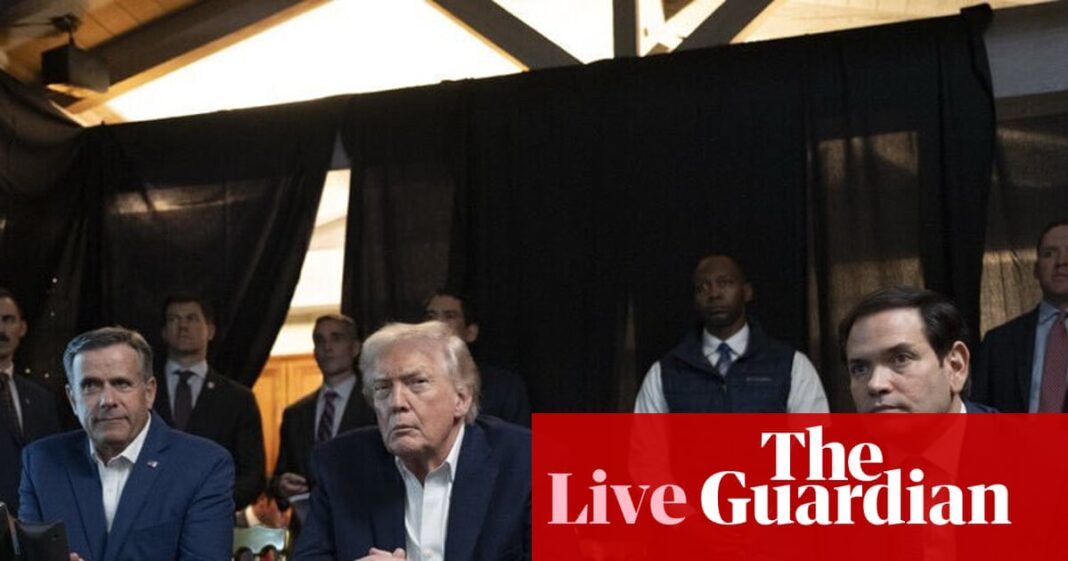
Summary: the day so far
It’s a lively day in international politics after the US intervention in Venezuela, with much comment and question about what happened, what it means and what’s to come. As many prominent figures are speaking up and developments continue on the ground in Caracas, we’ll keep you up to date with the news as it happens.
Here’s where things stand:
-
The governments of Spain, Brazil, Chile, Colombia, Mexico and Uruguay put out a strong joint statement saying the US actions in Venezuela “constitute an extremely dangerous precedent for peace and regional security and endanger the civilian population”, in an apparent reference to the Trump administration’s assertion that the US will “run” Venezuela and oversee oil production there.
-
Venezuela’s defense minister, General Vladímir Padrino López, issued a statement recognizing the vice-president, Delcy Rodríguez, as the country’s acting president. He said Venezuela’s military “categorically reject the cowardly kidnapping” of the dictator Nicolás Maduro and his wife, Cilia Flores by the US.
-
US Secretary of State Marco Rubio attempted to distance this weekend’s invasion of Venezuela from other invasions such as the US in Iraq more than 20 years ago, saying the events, despite their apparent similarities, are “very different.”
-
Rubio said on CBS that the US will continue to place pressure on Venezuela by seizing Venezuelan oil shipment boats. The Trump administration has repeatedly expressed a desire to take control of Venezuela’s vast oil reserves after ousting Maduro..
-
Prominent US Republicans including Rubio and Senators Tom Cotton and Jim Jordan, both senate committee chairmen, on Sunday were swiftly backpedaling on Donald Trump’s assertions in a press conference on Saturday, just hours after the military intervention in Venezuela and the snatching of Maduro, that the US “will run” Venezuela in transition. The men essentially talked about pressuring the country’s Venezuelan leadership to comply with US demands about its future conduct.
-
Pope Leo – the first American pontiff – said Venezuela must remain an independent country, as he called for respect of human rights after Nicolás Maduro’s capture by the US. Addressing crowds at the Vatican in Rome after Sunday prayer, the Pope – who spent years as a missionary in Peru – said: “The good of the beloved Venezuelan people must prevail over any other consideration.”
Key events
González says Maduro’s ouster ‘important but not enough’
Venezuelan opposition figure Edmundo González has said the US’s ousting of President Nicolás Maduro is important but not sufficient to return the country to normal.
“This moment represents an important step, but it is not enough,” he said in a post on Instagram on Sunday from exile in Spain.
Agence France-Presse quoted González as saying the country could return to normal only when “all Venezuelans who have been deprived of their freedom for political reasons are released” and the results of the 2024 election, which he claims to have won, are respected.
Oil prices slip despite Venezuela upheaval
The price of oil has slid in early Asian trade on Monday after the weekend’s events in Venezuela.
The drop comes amid ample global oil supply despite concerns about the political upheaval in Venezuela disrupting shipments, Reuters is reporting.
Brent crude futures fell 34 cents to $60.41 a barrel by 23.08 GMT while US West Texas Intermediate crude was at $56.91 a barrel, down 41c.
The US strike on Venezuela to extract President Nicolas Maduro from Caracas at the weekend inflicted no damage on the country’s oil production and refining industry, two sources with knowledge of operations at state oil company PDVSA said at the weekend.
Opec+ had its monthly meeting on Sunday and decided to hold output.
Analysts said there was plentiful oil supply in global markets, meaning any further disruption to Venezuela’s exports would have little immediate impact on prices.
Sibylla Brodzinsky
At the Simón Bolívar International Bridge, which spans the Táchira River, foot and vehicle traffic flowed as normal through the main border crossing between Venezuela and Colombia.
But a day after the extraordinary US capture and rendition of Venezuela’s leader, Nicolás Maduro, there was an air of uncertainty over what comes next.
On the Venezuelan side of the bridge, a member of the Bolivarian national guard said that his instructions from the military top brass had not changed.
“It’s a bit tense but we have been given no new orders,” he said.
Donald Trump said on Saturday that the US would now “run” the country for an indeterminate period of transition, but such claims seemed not to have filtered down to this corner of the country, 640km (400 miles) from Caracas. “Whoever governs us has to be a Venezuelan,” said the man.
In a sign that Venezuelan authorities are also on edge, his commanding officer angrily cut short the conversation and tore a page from a reporter’s notebook before suggesting that she return to the Colombian side.
“Things are complicated,” he said.
Kristi Noem, the US homeland security secretary, said on Sunday that the US wants a leader in Venezuela who will be “a partner that understands that we’re going to protect America” to stop drug trafficking and “terrorists from coming into our country”.
Noem indicated in an interview on Fox News Sunday that the immigration status of Venezuelan nationals living in the US under temporary protected status (TPS) was part of an administration-wide decision-making process that her department would follow.
“Venezuela today is more free than it was yesterday,” Noem said, adding that “every individual that was under TPS has the opportunity to apply for refugee status”. She added: “We need to make sure that our programs actually mean something, and that we’re following the law.”
Four months ago, Noem terminated the 2021 Biden-era designation of TPS for Venezuela, affecting over 250,000 Venezuelans living in the US, after determining it is “contrary to the US national interest”.
Those covered joined around 350,000 Venezuelans stripped of temporary protected status under a previous order.
Edward Helmore
US vice-president JD Vance has addressed the apparent disconnect between the Trump administration’s military operations in Venezuela and justifications based in part of an effort to curb the trafficking of the synthetic opioid fentanyl into the US.
In a post on X , Vance said he wanted to address “a lot claims [sic] that Venezuela has nothing to do with drugs because most of the fentanyl comes from elsewhere.”
“First off, fentanyl isn’t the only drug in the world and there is still fentanyl coming from Venezuela (or at least there was). Second, cocaine, which is the main drug trafficked out of Venezuela, is a profit center for all of the Latin America cartels. If you cut out the money from cocaine (or even reduce it) you substantially weaken the cartels overall. Also, cocaine is bad too! Third, yes, a lot of fentanyl is coming out of Mexico. That continues to be a focus of our policy in Mexico and is a reason why President Trump shut the border on day one.”
Outgoing Republican congresswoman Marjorie Taylor Greene raised the question of why the US was striking Venezuela if part of the purpose was to reduce fentanyl deaths in the US. (The administration said it was moving to list the synthetic opioid as a weapon of mass destruction.)
“The majority of American fentanyl overdoses and death come from Mexico,” Greene said. “Those are the Mexican cartels that are killing Americans. And so my pushback here is if this was really about narco-terrorists and about protecting Americans from cartels and drugs being brought into America, the Trump administration would be attacking the Mexican cartels.”
In his remarks, Vance said he’d seen “a lot of criticism” about oil.
“About 20 years ago, Venezuela expropriated American oil property and until recently used that stolen property to get rich and fund their narco-terrorist activities. I understand the anxiety over the use of military force, but are we just supposed to allow a communist to steal our stuff in our hemisphere and do nothing? Great powers don’t act like that. The United States, thanks to President Trump’s leadership, is a great power again. Everyone should take note”.
Maduro’s son vows the ousted president ‘will return’
Venezuelan president Nicolás Maduro’s son, Nicolás Ernesto Maduro Guerra, said his father’s supporters are more resolved than ever to support the ousted president, according to an audio shared on social media.
“They will not see us weak,” the younger Maduro said. “The President Nicolás Maduro will return. He will return. It’s been a day of shock, of course, we’re all in shock.”
“But we will take to the streets, we will convene the people, we will unite, we will form a nucleus around our highest political-military command with maximum unity,” he added.
The younger Maduro is currently a member of the Venezuelan national assembly and likely remains in Venezuela.
He was also recently indicted, alongside his father, in the southern district of New York. The indictment, including the younger Maduro, was released on Saturday.
Venezuelan president Maduro had been indicted in 2020 in the same case, alongside other top Venezuelan officials and former Colombian guerrilla leaders. But the indictment released on Saturday is the fourth and latest, accusing Maduro and others of other illegal activities since 2020. The latest indictment also included new defendants, including Maduro’s son and Maduro’s wife, Cilia Flores, who was also abducted and brought to New York.
“History will show who the traitors were,” the younger Maduro said in the audio. “History will reveal it. We will see it. But we need to concentrate on moving the nation forward, raise the flags of Chavez and bring back safe and sound Nicolás Maduro Moros and Cilia Flores.”
The Danish prime minister called on the US to stop “threatening” Greenland on Sunday, after Donald Trump commented he “absolutely” needed the territory, one day after the US’s abduction of Venezuelan president Nicolás Maduro, AFP reports.
Trump has repeatedly said he wants Greenland to become an annexed part of the US. The US government’s intervention in Venezuela has reignited fears the US will do the same to Greenland.
“I have to say this very clearly to the United States: it is absolutely absurd to say that the United States should take control of Greenland,” Danish prime minister Mette Frederiksen said in a statement late Sunday.
During a phone interview with the Atlantic magazine, Trump said that it was up to others to decide about the implications of the Venezuela military operation for Greenland.
“They are going to have to view it themselves. I really don’t know,” Trump was quoted as saying.
He added: “But we do need Greenland, absolutely. We need it for defense.”
Late Saturday, Katie Miller – wife of Trump’s deputy chief of staff, Stephen Miller – posted the contentious image of the Danish autonomous territory in the colours of the US flag on her X feed.
Her post had a single word above it: “SOON”.
The New York Times reports a number of factors finally led the Trump administration to invade Venezuela and abduct president Nicolás Maduro – including Maduro’s dance moves.
The newspaper reports that Trump presented Maduro with an ultimatum in December, telling him to leave office and go into exile in Turkey. Maduro refused.
Then, Maduro went back onstage this week, dancing to an electronic song that said “no crazy war” in his voice.
According to sources the Times spoke with, that was the last straw for the administration.
Maduro’s “regular public dancing and other displays of nonchalance in recent weeks helped persuade some on the Trump team that the Venezuelan president was mocking them and trying to call what he believed to be a bluff”, two confidential sources told the Times.
The New York Times and the Washington Post learned of the secret US government raid to abduct Venezuelan president Nicolás Maduro before it happened, but did not publish what they knew “to avoid endangering US troops”, Semafor reports.
The New York Times and the Post knew of the raid, approved by Donald Trump on Friday night, soon before it was scheduled to begin. But the newsrooms and the Trump administration were in contact and that the administration urged the newspapers to hold off on their reporting, the Semafor report says.
More than 40 Venezuelans were killed in the operation and some US personnel were injured, US and Venezuelan authorities announced.
José Olivares
The Colombian guerrilla group, the National Liberation Army (Ejercito de Liberación Nacional), also known as the ELN by its acronym in Spanish, condemned the US invasion of Venezuela on Saturday, calling for a stand against the US government in the region.
In a statement by the ELN’s central command, the insurgent group said it “joins the voices of the international community that reject and condemn the attacks by the United States against Venezuela, which violate its sovereignty”.
The ELN also stressed that the US government’s further intervention in the region should be confronted.
“We stand with all patriots, democrats, and revolutionaries from Colombia and the continent to confront the imperial plans against Venezuela and the people of the South,” the ELN’s central command wrote in their statement.
The statement was distributed among ELN Telegram groups and was viewed by the Guardian.
The ELN is a far-left insurgent group in Colombia that has engaged in a longtime conflict with the Colombian government since the 1960s.
In 1997, the US government declared the ELN to be a terrorist organization and has accused the group of engaging in cocaine trafficking and other crimes to further its political insurgency. Throughout the civil conflict in Colombia, the US government provided support to Colombian armed forces to fight the ELN and other guerrilla groups, including the Revolutionary Armed Forces of Colombia (FARC), the latter of which signed a peace treaty in 2016.
The Colombian government and the ELN have attempted, in various instances, to engage in peace talks to end the conflict, similar to the ones with the FARC. Those talks have been unsuccessful, including recently under the current presidency of Gustavo Petro.
The ELN has evolved throughout the years and has increasingly ventured into Venezuela, expanding its reach and increasing its strength. According to the most recent unsealed indictment against Venezuelan president Nicolás Maduro and other co-defendants, including his wife, Maduro provided protection to the ELN and other far-left Colombian guerrilla groups.
One of Maduro’s co-defendants, former Interior and Justice Minister Ramón Rodriguez Chacín, was allegedly “assigned” by Maduro “to provide the FARC and ELN with protection and support”, the indictment reads.
During the fall, the Trump administration began striking a number of boats in the ocean near South America, claiming without evidence that traffickers and “narcoterrorists” were transporting drugs. In October, defense secretary Pete Hegseth announced that the US military targeted and struck a boat allegedly affiliated with the ELN, killing all three men onboard.
Nearly all countries within the European Union, except Hungary, issued a statement about the US-Venezuela crisis, saying the “will of the Venezuelan people” was the only way to restore the country’s democracy, Reuters reports.
“The European Union calls for calm and restraint by all actors, to avoid escalation and to ensure a peaceful solution to the crisis,” 26 EU countries said in a statement.
“Respecting the will of the Venezuelan people remains the only way for Venezuela to restore democracy and resolve the current crisis,” the statement added.
Donald Trump is now fine with the principle of regime change imposed on another country by the United States, according to a short telephone interview he conducted on Sunday morning.
Talking to the Atlantic, the US president said, after the US removal by force of Venezuelan president Nicholás Maduro and Trump’s rapid assertions that the US will run the country in the interim: “You know, rebuilding there and regime change, anything you want to call it, is better than what you have right now. Can’t get any worse.”
His interviewer pointed out that Trump had specifically in the past campaigned against a policy of favoring regime change in other countries, and he campaigned in 2024 on a policy of “America first” and shying away from military intervention abroad.
Trump didn’t explain how he thought removing the president of Venezuela and trying to engineer how that country will be run was or will turn out to be a fundamentally different kind of venture from the US invading Iraq, removing Saddam Hussein and operating inside that country.
What he did say was: “I didn’t do Iraq. That was Bush. You’ll have to ask [President George W] Bush that question, because we should have never gone into Iraq. That started the Middle East disaster.”
Trump threatens Venezuela’s interim leader
Donald Trump on Sunday threatened Venezuela’s interim leader, Delcy Rodriguez, that if she did not comply with demands from the US that she could pay a “bigger price” than the captured president Nicolás Maduro.
The US president conducted a short telephone interview with The Atlantic magazine as he was on his way to play golf in Florida.
“If she doesn’t do what’s right, she is going to pay a very big price, probably bigger than Maduro,” Trump said.
The US has commandedVenezuela to stop involvement in “narco terrorism” drug smuggling operations to the US, distance itself from US adversaries such as Cuba, Iran and militant proxies such as the Hezbollah group and facilitate the US overseeing its oil operations.
He did not explain his comments on Saturday that the US will run Venezuela, which senior Republican figures such as secretary of state Marco Rubio were backpedaling from at speed on Sunday.
Summary: the day so far
It’s a lively day in international politics after the US intervention in Venezuela, with much comment and question about what happened, what it means and what’s to come. As many prominent figures are speaking up and developments continue on the ground in Caracas, we’ll keep you up to date with the news as it happens.
Here’s where things stand:
-
The governments of Spain, Brazil, Chile, Colombia, Mexico and Uruguay put out a strong joint statement saying the US actions in Venezuela “constitute an extremely dangerous precedent for peace and regional security and endanger the civilian population”, in an apparent reference to the Trump administration’s assertion that the US will “run” Venezuela and oversee oil production there.
-
Venezuela’s defense minister, General Vladímir Padrino López, issued a statement recognizing the vice-president, Delcy Rodríguez, as the country’s acting president. He said Venezuela’s military “categorically reject the cowardly kidnapping” of the dictator Nicolás Maduro and his wife, Cilia Flores by the US.
-
US Secretary of State Marco Rubio attempted to distance this weekend’s invasion of Venezuela from other invasions such as the US in Iraq more than 20 years ago, saying the events, despite their apparent similarities, are “very different.”
-
Rubio said on CBS that the US will continue to place pressure on Venezuela by seizing Venezuelan oil shipment boats. The Trump administration has repeatedly expressed a desire to take control of Venezuela’s vast oil reserves after ousting Maduro..
-
Prominent US Republicans including Rubio and Senators Tom Cotton and Jim Jordan, both senate committee chairmen, on Sunday were swiftly backpedaling on Donald Trump’s assertions in a press conference on Saturday, just hours after the military intervention in Venezuela and the snatching of Maduro, that the US “will run” Venezuela in transition. The men essentially talked about pressuring the country’s Venezuelan leadership to comply with US demands about its future conduct.
-
Pope Leo – the first American pontiff – said Venezuela must remain an independent country, as he called for respect of human rights after Nicolás Maduro’s capture by the US. Addressing crowds at the Vatican in Rome after Sunday prayer, the Pope – who spent years as a missionary in Peru – said: “The good of the beloved Venezuelan people must prevail over any other consideration.”
Senator Jim Jordan spoke further on Sunday to echo Trump’s claims accusing Venezuela of taking oil that belonged to the US government.
“When that country took assets that belonged to American companies — that’s wrong,” Jordan said on CNN’s State of the Union. “That’s all President Trump is saying is going to change in the future relative to oil. I think that makes sense. They took property from American companies. That makes sense that there’s going to be some kind of compensation, some kind of reckoning for that.”
After Hugo Chavez was elected president in 1999, his “Bolivarian Revolution” movement nationalized a number of privately-run oil fields and reserves in Venezuela, including some owned by international oil companies. Resources from the state-owned petroleum company were then used to fund social programs in the country.
Trump on Saturday accused Nicolás Maduro, Chavez’s successor, of stealing oil from the US. In recent months, as the Trump administration’s pressure on the country increased, the administration seized a Venezuelan oil ship. Trump later said the US would keep the oil or sell it.
Republican Congressman and chairman of the Judiciary Committee Jim Jordan said on Sunday that the US government’s abduction of Venezuelan president Nicolás Maduro and his wife were consistent with the “America First” philosophy Trump ran on.
“Getting a bad guy brought to justice who’s had a five-year arrest warrant, that is certainly consistent with that theme and that message as well,” Jordan said during CNN’s State of the Union. “So I think the American people appreciate that. And, frankly, I think that’s the message we go tell the American people in this midterm election. President Trump and Republicans did what we said we would do. We’re doing that.”
Jordan’s claims contrast with hardline Maga Republican Rep. Marjorie Taylor Greene’s comments, who called out the Trump administration’s actions, saying they did not follow “America First.”